In 2018 this page forecast that federal spending on blockchain would triple within five years. The idea at the time was that agencies would run supply chains, land records and identity on distributed ledgers. A lot of pilots started. Very few made it into real production systems.
Blockchain did get into Washington in the end, just not through agency IT budgets. It came in through policy.
Why the pilots stalled
Most government blockchain projects ran into the same wall. A shared ledger solves trust between parties who don’t trust each other, but a single agency running its own records already trusts itself. A normal database with good audit logs did the job for less money. So the pilots proved the technology worked and then quietly stopped.
What changed in 2025
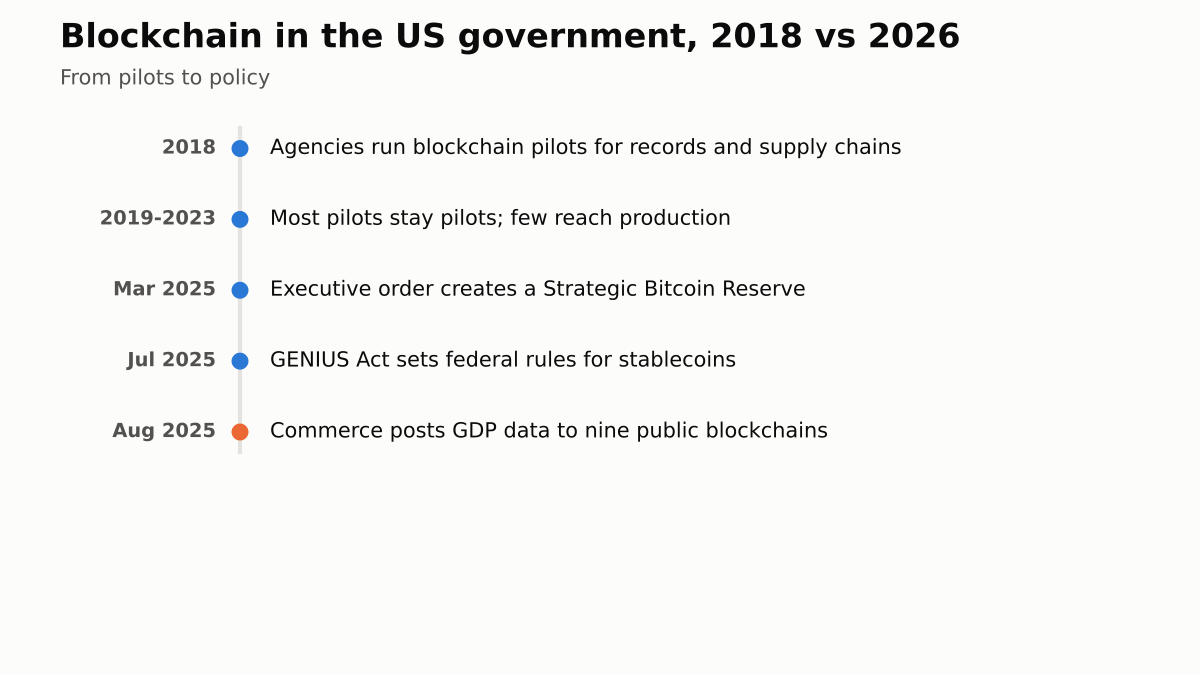
The current administration treats crypto as an industry to promote. In March 2025 an executive order created a Strategic Bitcoin Reserve, built from bitcoin the government already held from seizures. In July 2025 the GENIUS Act set federal rules for dollar-backed stablecoins, which the administration sees as a way to extend the dollar’s reach.
Then in August 2025 the Commerce Department began posting GDP data to public blockchains. It publishes a cryptographic hash of each GDP release, and in some cases the headline number, on nine networks: Bitcoin, Ethereum, Solana, Tron, Stellar, Avalanche, Arbitrum, Polygon and Optimism. Officials described it as an extra channel, not a replacement for the normal release, and it works with oracle networks Chainlink and Pyth to feed the data into on-chain finance.
Critics pointed out that tamper-proof publishing existed long before blockchains, and that posting a hash doesn’t make the underlying number more accurate. Both points are fair. The real effect is symbolic and practical for crypto markets: prediction markets and tokenized assets can now read official data straight from a chain.
Then and now
| 2018 | 2026 | |
|---|---|---|
| Main driver | Agency IT pilots | White House crypto policy |
| Typical use | Records, supply chains, identity | Reserves, stablecoin rules, publishing data on public chains |
| Who spends | Agency innovation budgets | Mostly the private crypto industry |
| Status | Many pilots, little production | Real policy, still little in core agency systems |
So the government did adopt blockchain, but as a regulator, an asset holder and a publisher, not as a heavy user. For more on crypto and financial technology, see the Technology desk.
